Is ChatGPT really destroying Chegg's fortunes?
I am sure we have all seen the news of Chegg's stock price plumetting just after announcing its previous quarter's results. 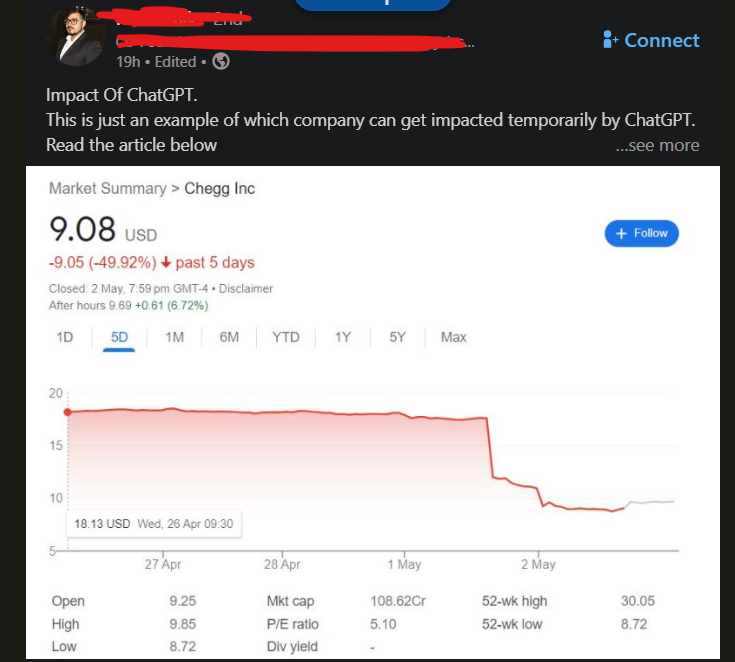
Here's an example that I saw on my LinkedIn feed. However, there has been a decline in it's stock price for a far longer time than ChatGPT was released.**
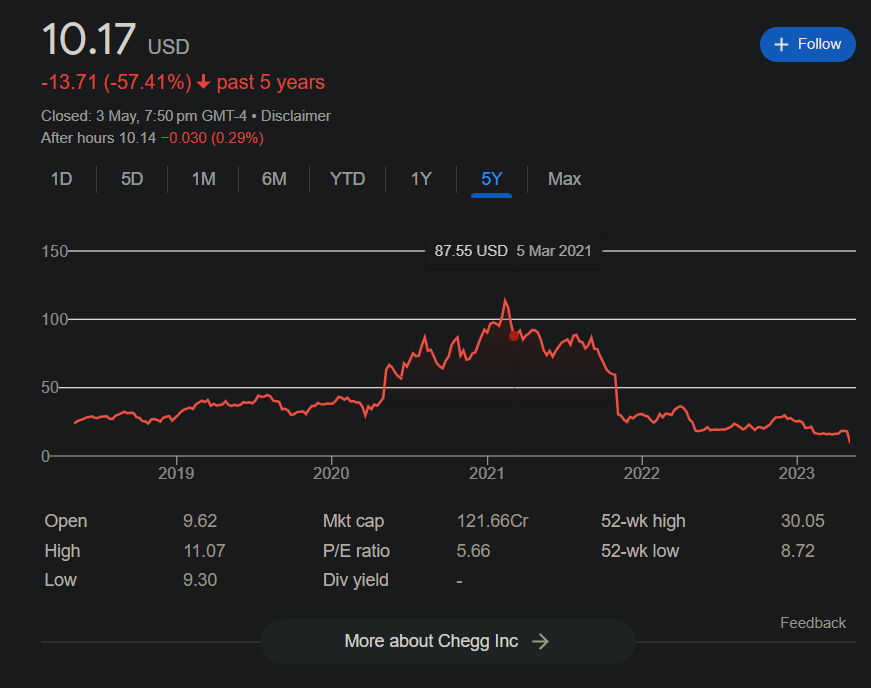
For example, here's the stock price for the past few years whereas ChatGPT was initially released on November 30, 2022 (as per Google).
The CEO released a statement saying
Chegg signaled the rising popularity of viral chatbot ChatGPT was pressuring its subscriber growth and prompted it to suspend its full-year outlook, sending shares of the company 47% lower in early trading on Tuesday. "Since March, we saw a significant spike in student interest in ChatGPT. We now believe it's having an impact on our new customer growth rate," said Chegg CEO Dan Rosensweig. There are fears Chegg's core business could become extinct as consumers experiment with free artificial intelligence (AI) tools, said analyst Brent Thill at Jefferies, which downgraded the stock to "hold".
However, the company has lost quite a bit of its valuation since 2021, and I feel not all of it can be attributed to ChatGPT and the rising popularity of LLMs. I am not denying there is a correlation, but we should not be quick to blame one single factor for something like this. For example, as per this article by Motley Fool
Chegg (CHGG 12.00%) is an education technology company that primarily serves college students. As a result, it is dependent on the total enrollment levels at colleges. With fewer students, it leaves a smaller market for Chegg to capture. That is precisely what has happened in the U.S. since the pandemic's onset. That's understandable. Shooting for a college degree is challenging already, but even more so during a pandemic. Given that backdrop, it's not surprising that in the U.S., one million students have forgone or postponed a college education over the last two years. Let's look closer at the effect it's having on Chegg. Declining college enrollment is a challenge Note Chegg runs on a subscription business model. Students pay between $15 to $20 per month to access the Chegg learning platform. In return, the curious minds can learn from Chegg's 79 million pieces of proprietary content (typically step-by-step solutions to commonly asked questions). Additionally, for queries Chegg does not already have, students can ask 20 questions per month -- answered by Chegg's subject-matter experts. This is how Chegg has built the treasure trove of assets.
Here are some more sources 1 2 3
It remains to be seen what the wider impact of LLMs will be on society. There are serious threats of prompt injections and hallucinations by LLMs are all too common. It will be a while before companies like OpenAI and Microsoft will be able to find a fix for this. Blaming one thing for the failure of a company to make money is easy. However, I am hoping for the best for Chegg, considering I used it extensively during my undergrad.
*Please note that I do not have a background in finance or stock market analysis, so any views or opinions I express are based solely on my own personal research and understanding."